Improving Your Sim Racing – Insights From GITGUD Racing
Improving your sim racing performance isn’t about buying the most expensive hardware or chasing alien lap times overnight. According to GITGUD Racing, real progress comes from structured practice, correct fundamentals, and data-driven self-analysis — the same principles used by real-world racing drivers.
In this guide, we break down proven sim racing improvement strategies, inspired by GITGUD Racing’s coaching philosophy, to help you become faster, more consistent, and more confident on track.
Who Is GITGUD Racing (And Why Their Insights Matter)
GITGUD Racing is widely known in the sim racing community for focusing on:
- Driver fundamentals over shortcuts
- Repeatable performance, not hot laps
- Coaching methods rooted in real motorsport principles
Instead of “magic setups” or unrealistic tricks, GITGUD Racing emphasizes driver skill development — which is exactly what most sim racers need to break through performance plateaus.
The Biggest Mistake Sim Racers Make When Trying to Improve
Most sim racers focus on:
❌ Setup changes
❌ Hardware upgrades
❌ Copying alien laps
GITGUD Racing highlights a critical truth:
You don’t have a setup problem — you have a driving fundamentals problem.
Until your inputs are consistent, setups won’t save you.
Step 1: Master Consistency Before Speed
According to GITGUD Racing, consistency is the foundation of speed.
What Consistency Really Means
- Hitting braking points every lap
- Applying throttle progressively
- Using the same racing line under pressure
- Minimizing steering corrections
How to Train Consistency
- Run long stints, not hot laps
- Focus on lap time variance, not best lap
- Ignore lap time delta for entire sessions
👉 Suggested internal anchor text:
how to improve sim racing consistency
Step 2: Fix Your Braking (The Biggest Lap Time Gain)
Braking accounts for the largest time gains in sim racing.
Common Braking Mistakes
- Braking too late
- Slamming brakes to 100%
- Releasing brakes too quickly
- Over-slowing corner entry
GITGUD Racing Braking Principles
- Brake earlier, but brake less
- Trail brake smoothly into the corner
- Release brake pressure progressively
- Let the car rotate naturally
Even small braking improvements can unlock seconds per lap.
👉 Suggested internal anchor text:
sim racing braking techniques
Step 3: Learn Proper Throttle Control
Speed doesn’t come from flooring the throttle — it comes from maximizing grip.
Key Throttle Insights From GITGUD Racing
- Smooth throttle = more traction
- Early throttle only works if steering angle is low
- Aggressive throttle kills exit speed
Training Tip
Practice throttle modulation drills:
- Gradual application
- No sudden spikes
- Prioritize exit stability
👉 Suggested internal anchor text:
throttle control in sim racing
Step 4: Stop Chasing Perfect Racing Lines
GITGUD Racing emphasizes adaptability over perfection.
Why Perfect Lines Fail
- Traffic changes braking points
- Tire wear alters grip
- Weather and fuel load affect balance
Better Approach
- Learn reference zones, not fixed points
- Adapt braking and turn-in dynamically
- Prioritize exits over corner entry
👉 Suggested internal anchor text:
sim racing racing line fundamentals
Step 5: Use Data — But Don’t Obsess Over It
Telemetry and replays are powerful tools only when used correctly.
How GITGUD Racing Uses Data
- Compare inputs, not lap times
- Look at brake traces and throttle overlap
- Identify inconsistency patterns
What to Avoid
❌ Over-analyzing every lap
❌ Copying alien inputs blindly
❌ Ignoring your driving style
👉 Suggested internal anchor text:
how to use telemetry in sim racing
Step 6: Hardware Setup Matters (But Less Than You Think)
Good hardware helps — but it won’t fix poor technique.
Minimum Hardware for Improvement
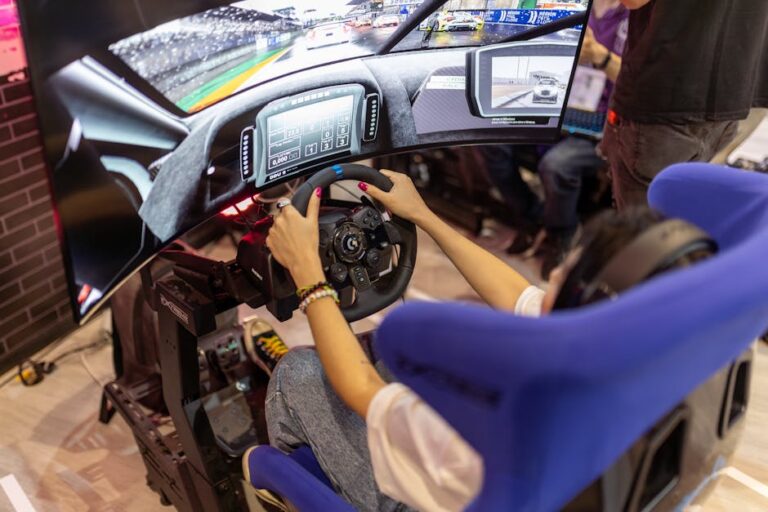
- Stable rig (no flex)
- Load-cell or consistent brake pedal
- Correct seating and FOV
Direct drive wheels help with feedback clarity, but fundamentals still matter more.
👉 Suggested internal anchor text:
best direct drive racing wheels
👉 Suggested internal anchor text:
sim racing cockpit setup guide
Step 7: Train Your Mind, Not Just Your Hands
Sim racing is mental as much as physical.
Mental Skills GITGUD Racing Emphasizes
- Patience under pressure
- Resetting after mistakes
- Avoiding emotional driving
- Staying focused during long stints
A calm driver is a fast driver.
👉 Suggested internal anchor text:
mental training for sim racing
Step 8: Structure Your Practice Sessions
Random driving leads to random results.
GITGUD Racing Practice Structure
- Warm-up laps (no pushing)
- Consistency phase
- Focused skill drill (braking, exits, etc.)
- Long stint simulation
- Review and notes
This structure accelerates learning dramatically.
Why Most Sim Racers Plateau (And How to Break Through)
Plateaus happen because:
- Drivers repeat the same mistakes
- No structured feedback loop
- Too much focus on lap time
Breaking through requires:
- Intentional practice
- Objective self-review
- Patience
Final Verdict: The GITGUD Racing Approach Works
Improving your sim racing isn’t about shortcuts — it’s about building real driving skill.
GITGUD Racing’s insights prove that:
- Fundamentals beat fancy setups
- Consistency unlocks speed
- Discipline beats talent
If you apply these principles consistently, your lap times will drop — and stay there.

My name is Michael “Mick” Carter, and I’m a dedicated sim racing enthusiast with a deep love for motorsport. I first discovered sim racing in 2015 when a friend introduced me to a Logitech G27 and Assetto Corsa—an experience that immediately hooked me. Since then, I’ve gone from basic gear to advanced direct drive setups, VR headsets, and custom racing rigs, constantly refining my driving technique and equipment.
I mainly race in iRacing, ACC, and rFactor 2, focusing on GT3 endurance and open-wheel events. I’m not a professional driver—I’m simply someone who enjoys the craft of racing: learning car behavior, improving lap times, and battling for position with respect and skill.
I share what I’ve learned so others can build setups they enjoy and grow their own passion for sim racing. For me, the joy is in improving, one race at a time.
Owner at SimRacingCockpits.Com